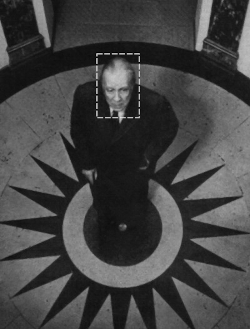
(Link a la versión en Español. Inspired by the Borges: Ecos de un Nombre exhibition.)
Among the many aesthetic triumphs of Christian theology, not the least is Dante’s rewriting of a Hell whose rigorous geography mirrors the merciless fecundity of its authors. The libraries of writings on the Florentine poet rival in volume and tedium the mountain on which he set his Purgatory. None of the most recent of these texts mentions—not even to refute—the ancient and forgotten heresy that regarded the Comedy not as the creation of an individual but as a divinely dictated and cosmologically precise description. Even more obscure is the hypothesis that synthesizes both: that Dante’s Hell is, down to the smallest detail, the hell that awaited him after his death (and so on for the other, less credible or interesting, soteriological possibilities).
I cannot say for certain that these theological obsolescences are relevant to the story Borges told me one winter night—a night whose combination of storm, window, fire, and fireplace provided a setting more appropriate to fiction than to memory. I mention them simply because they are the part I remember of our conversation before he, without prelude or explanation, described to me a dream he claimed to have had in his youth. He offered no details about when or where he had had this dream; from a few words and silences, I deduced that it had been during those years when the ambition for literary glory—the most vain of vanities—had not yet coincided with the creation of those texts which, in the privacy of his conversation, he acknowledged were good enough to make him disdain defending them.
The events of the dream can be recounted without much complexity. Borges was enterin or had already entere a place he recognized as an asylum and, simultaneously, a museum and perhaps a city. A modest crowd accompanied him, wandering aimlessly through the chapels, bookstores, and cafés. In passing, he mentioned strange garments that seemed normal to him during the dream and, through a doorway, a glimpse of an almost familiar cemetery. His steps led him inevitably to a large hall that was less well-lit than the others. Large, semitransparent pages divided the space, suggesting a labyrinth that nevertheless had only one possible direction. The people in the room frequently paused in their walk along the wide corridors to examine the walls, from which hung an uncategorizable multitude of items: photos, magazine pages, notebook sheets, entire books. Tables with transparent surfaces held similar objects and even stranger ones.
Unable to understand the logic behind this collection but not daring to ask the other people in the room, Borges continued on his way until he reached the center of the labyrinth. There he encountered an old man with a suspicious expression. In the blindness of his eyes and the openly dishonest cadence of his incessant words—for the man spoke as if he feared silence the way others fear darkness—Borges imagined for a second the redundant concept of a contemporary Homer, but he recognized no mention or plagiarism of Odysseus, Achilles, or even Troy in the man’s words. Labyrinthine phrase upon labyrinthine phrase, stories upon stories in mirrored texts, Borges listened to the man with unease that, as the minutes passed, turned into fear. Lacking the words at that moment, he told me there was something horrifically flat about him. Anatomy had never been of more than superficial interest to Borges, but it was precisely his surfaces—the movements of his hands and face—that, without being obviously inhuman, induced an insidious and terrible doubt.
Worse still was the horror of his diction and his words. That was all Borges said on the matter. Not out of forgetfulness but, I am sure, out of a visceral aversion that had survived the decades. He told me nothing more about the dream, and we moved on to discuss I don’t recall what etymology.
That the objects in the labyrinth represented a biography of the man at the center of the labyrinth is obvious. I do not believe I am failing in my duty as a friend by stating that I have no doubt he was also Borges. What prevents me from publishing these pages that my vanity keeps locked away in my safe is not the risk of making public some psychoanalytic banality of fleeting interest. I think of the walls and tables in that room, of the books and texts preserved unchanged in the biography of the blind man at the center of the labyrinth with his inhumanly uniform diction and movements not quite human. I recall my friend’s youthful ambition, the haughty certainty of his middle age, his obsessions with labyrinths and mirrors, his venomous and resigned precision when speaking of memories and echoes.
My friend was Borges. In the most literal sense he wrote or dictated Borges’s books, gave his lectures, and received his awards. He never spoke of divine inspiration, nor did he believe in a God from whom it might come. But ever since that night when he told me about that dream – shortly before he died and I believe because of it – many exhibitions have been organised in his name. I am sure there will be more and for a long time to come, and I am sure I won't go to any of them. I said goodbye to my friend at the exit door of his final labyrinth. I do not wish to meet him at the entrance to another, more ancient one. Even less, and in my dreams this is the nightmare from which I wake up grateful, with the blind man at its inescapable centre.
(Link to the English version. Inspirado por la exhibición Borges: Ecos de un Nombre.)
De los muchos triunfos estéticos de la teología Cristiana el menor no es la reescritura por parte de Dante de un Infierno cuya rigurosa geografía replica la inmisericorde fecundidad de sus autores. Las bibliotecas escritas sobre el poeta florentino rivalizan en volumen y tedio la montaña en la que instaló su Purgatorio. Ninguno de los más recientes de esos textos menciona, siquiera para refutar, la antigua y olvidada herejía que consideraba a la Comedia no una creación individual sino una descripción divinamente dictada y cosmologicamente precisa. Incluso más oscura es la hipótesis que sintetiza ambas: que el Infierno de Dante es, hasta su menor detalle, el infierno que le esperaba tras su muerte (y así para las otras, menos creíbles o interesantes, posibilidades soteriológicas).
No puedo asegurar que estas obsolescencias teológicas sean relevantes a la historia que me contó Borges una noche de invierno cuya combinación de tormenta, ventana, fuego, y chimenea era un marco más propicio para la ficción que para la memoria. Las menciono simplemente porque son la parte que recuerdo de nuestra conversación antes de que, sin preludio ni explicación, me describiese un sueño que postulaba haber tenido en su juventud. No ofreció detalles de cuándo y dónde había tenido este sueño; de algunas palabras y silencios deduje que había sido en esos años donde la ambición de gloria literaria -- la más vana de las vanidades -- no coincidía todavía con la creación de aquellos textos que, en la privacidad de su conversación, reconocía suficientemente buenos como para desdeñar su defensa.
Los eventos del sueño pueden narrarse sin mayor complejidad. Borges entraba o ya había entrado a un lugar que reconocía como un asilo y, simultáneamente, un museo y tal vez una ciudad. Una moderada multitud lo acompañaba, recorriendo sin objetivo reconocible las capillas, librerías, y cafés. Mencionó al pasar extrañas vestimentas que durante el sueño le parecieron normales y a través de una puerta una visión de un cementerio casi familiar. Sus pasos lo llevaron ineludiblemente a una gran sala menos iluminada que las otras. Grandes páginas semitransparentes disectaban el espacio con la sugerencia de un laberinto que sin embargo no tenía más que una dirección posible. La gente en la sala detenía frecuentemente su caminar por los anchos corredores para examinar sus paredes de las que colgaba una multitud incatalogable: fotos, páginas de revistas, hojas de cuadernos, libros enteros. Mesas de superficie transparente guardaban objetos similares o incluso más extraños.
Incapaz de entender la lógica de esta colección pero sin atreverse a preguntar a las otras personas en la sala Borges continuó su camino hasta llegar al centro del laberinto. Allí encontró un hombre viejo de expresión suspicaz. En la ceguera de sus ojos y la abiertamente deshonesta cadencia de sus incesantes palabras -- pues el hombre hablaba como si temiese el silencio como otros temen la oscuridad -- imaginó por un segundo el redundante concepto de un Homero contemporáneo, pero no reconoció en sus palabras mención o plagio de Odiseo, un Aquiles, o siquiera una Troya. Frase laberíntica sobre frase laberíntica, historias sobre historias en textos espejados, Borges escuchó al hombre con inquietud que al pasar los minutos se transformó en miedo. Sin tener las palabras en ese momento, me dijo que había algo horrendamente plano en él. La anatomía no había sido nunca para Borges de interés más que superficial, pero justamente eran sus superficies, los movimientos de sus manos y rostro, los que sin ser obviamente inhumanos inducían una duda insidiosa y terrible.
Peor aún el horror de su dicción y sus palabras. Esto fué todo lo que dijo Borges al respecto. No por olvido sino, estoy seguro, por un desagrado visceral que había sobrevivido a las décadas. Del sueño no me dijo más y pasamos a discutir no recuerdo qué etimología.
Que los objetos en el laberinto representaban una biografía del hombre en el centro del laberinto es una obviedad. No creo faltar a mi deber como amigo al afirmar que no tengo duda de que era también Borges. Lo que previene mi publicación de estas páginas que mi vanidad preserva en mi caja fuerte no es el riesgo de dar carácter público a alguna banalidad psicoanalítica de fugaz interés. Pienso en las paredes y las mesas en esa sala, en los libros y en los textos preservados incambiables en la biografía del ciego en el centro del laberinto de dicción inhumanamente uniforme y movimientos no del todo humanos. Recuerdo la joven ambición de mi amigo, la altanera certeza de su mediana edad, sus obsesiones con laberintos y espejos, su venenosa y resignada precisión al hablar de memorias y ecos.
Mi amigo fué Borges. En el más físico de los sentidos escribió o dictó los libros de Borges, dió sus conferencias, recibió sus premios. Nunca habló de inspiración divina ni creía en un Dios del cual pudiese venir. Pero desde esa noche donde me contó ese sueño, poco antes de morir y creo que por eso, han inagurado muchas exhibiciones en su nombre. Estoy seguro de que habrá más y por mucho tiempo, y estoy seguro de que no asistiré a ninguna. Me despedí de mi amigo en la puerta de salida de su último laberinto. No deseo encontrarme con él en la entrada de otro mucho más antiguo. Ni mucho menos, y en mis sueños esta es la pesadilla de la que despierto agradecido, con el hombre ciego en su inescapable centro.