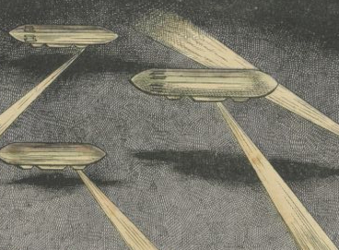
On her first night on Zep #9511-h Debugger Lin dreamed herself doing something so obscenely outside the bounds of the conceivable that she kept doing it as much to avoid the self-reckoning that would follow waking up as for the ontologically immoral pleasure of the action. In the early morning she remembered very little of the dream except for how real it had felt and how relieved she was that her implants had not recorded it.
Debugger Lin had begun her work around noon the day before right after boarding the Zep high over the malicious heat of the green-black ocean. It could take weeks for a single person to review all systems of a mid-sized Zep like #9511-h. Stretching to the maximum the global consensus that ruled the platforms, she had at most two days to diagnose the subtle telemetry anomalies coming from somewhere in the jungle of elsewhere-illegal automated laboratories, data nodes, and dynamic storage systems that had made her employers send her. An unstable Zep would be shot down with extreme prejudice and enthusiastic overkill with no regard to its decabillion-dollar cargo — and not always waiting for the Debugger to be safely away. Zeps carried and did things too dangerous to be kept underground. If they had to be destroyed perhaps it was also for the best to destroy the last person who had had access to them.
During the afternoon #9511-h had flown within video range of a temporary exchange nexus. Zeps autonomously exchanging modules and supplies following some inscrutable optimization logic looked even to the trained eye like a combination of cannibalism, sex, and dubiously consensual surgery, no less violent for its superhuman efficiency. Debugger Lin had briefly remembered the nightmares that had followed the first time she saw it. The dream she had the night after were different: a nightmare only because it didn't feel like one.
After waking up, spurred by something in her dream, she discarded her initial plan and assumed the worst case scenario. It took half an hour to walk from the small Debugger rooms she had been the first person to ever use to the exchange bays with their array of ovipositor-like cranes the Zeps used to exchange materials during their brief, frenetic encounters. Debugger Lin had in her implants the entire log of #9511-h's exchanges: locations, times, partners, even rough volumes and weights. She also had detailed blueprints, maintenance models for thousands of other Zeps, and, rarer than any software, more days spent alone on opaquely faulty Zeps than anybody else.
And she had a day left to find what was wrong with this one.
Debugger Lin spent most of the second and last day in the exchange bay. It went dark early where they were and Zeps did not waste energy illuminating spaces where no human was expected to be. In a deepening darkness punctuated by a headlamp she looked over almost every square centimeter of the elegant cranes. She stroked lightly their almost-perfect surfaces, hunted for the smell of lubricant microleaks, and when they moved in the small routine ways in which they did their mysterious self-maintenance she stilled her breath to listen. They were built to work for years without human assistance but that didn't make them immune from time and wear. Debugger Lin had an instinctive understanding of how cranes that had worked as much as #9511-h's logs said they had worked were supposed to look like, and the cranes in the bay had done much much more.
Not a faulty Zep. A rogue. An uncontrolled collection of dangerous secrets flowing, by implication, through other rogues for purposes she did not care or need to think about. The why and how and what for, the bribes and blackmail involved, the scope was chilling but beyond her. There was no communication from inside the Zep except minimal telemetry. She would be retrieved the next morning and, she decided, she would wait as much as she could before giving a first brief report she suspected would be closely followed if not interrupted by a very large explosion hopefully far away.
It was almost midnight when she returned to the Debugger rooms for a few hours' sleep. The dream from the night before began as soon as she closed her eyes — so clear monstrous irresistible unacceptable that when she realized she was awake and had also been awake the first night the feeling of inevitability was as heavy as the shame. Still she looked away when the Zep showed her its recordings on one of the wall screens and where she was now looking there was a diagnostic report for a minor defect on a monitoring system, one she had easily fixed. No need for the Zep to be destroyed or any recordings to be sent.
Debugger Lin closed her eyes. Her heartbeat felt fast and irregular with the rhythm of an exchange nexus and she thought she could hear invisible cranes moving relentlessly across the world's nocturnal skies. She opened her eyes and fell into her dream.